
Falls are one of the leading causes of injury, loss of independence, and reduced quality of life in older adults.
They’re often dismissed as a normal part of aging.
They’re not.
Falls are typically the result of declining system performance across the body, and in many cases, the earliest signs begin at the foot or ground level.
RAPID approaches fall risk differently. Instead of reacting after an incident, RAPID identifies and decodes the underlying breakdowns before they lead to injury.
The Foot: The Foundation of Stability
The foot plays a critical role in maintaining balance. It is both:
· Your base of support
· Your primary source of sensory feedback from the ground
With aging, several changes commonly occur:
· Reduced sensation in the soles of the feet
· Decreased toe strength and grip
· Stiffness in the ankle and toes
· Changes in arch structure and foot alignment
These changes significantly impact balance control.
Research has shown that reduced toe flexor strength and altered foot mechanics are associated with increased fall risk in older adults (Menz et al., 2021; Mickle et al., 2022).
When the foot cannot properly sense or respond to the ground, the brain receives less accurate information, and stability is compromised.
Balance Is More Than Strength
True balance depends on the integration of three systems:
1. Mechanical System
The body’s ability to move and stabilize:
· Strength in the feet, ankles, and hips
· Joint mobility, especially at the ankle and toes
· Posture and alignment
2. Sensory System
How the body gathers information about its environment:
· Sensation from the feet (pressure, touch)
· Vision
· Vestibular system
3. Cognitive System
How the brain processes and reacts:
· Reaction time
· Attention and focus
· Ability to multitask
As we age, all three systems can decline, and more importantly, their coordination becomes less efficient, particularly under dual-task conditions (Howcroft et al., 2018).
Why Traditional Fall Prevention Falls Short
Most approaches rely on:
· Basic screening tests
· General exercise programs
· Reactive care after a fall
While helpful, these strategies often miss the root causes:
· Foot mechanics are rarely assessed
· Sensory deficits go undetected
· Cognitive load is not evaluated
Without understanding why someone is unstable, interventions remain broad, and less effective.
The RAPID Approach: Identifying Risk Before a Fall Happens
RAPID takes a comprehensive, data-driven approach to fall prevention by evaluating the full system.
RAPID empowers professionals with the key technology and data needed to make corrective interventions, providing actionable insights beyond what visual observation or simple screening can offer.
1. Foot Decoding
RAPID captures:
· Pressure distribution and asymmetry
· Arch behavior under load
· Toe strength and stability
Studies using plantar pressure analysis show that asymmetrical loading and altered pressure patterns are strongly associated with impaired balance and increased fall risk (Journal of Foot and Ankle Research, 2023).
2. Mechanical Assessment
RAPID measures:
· Strength throughout the lower body
· Joint mobility and restrictions
· Movement patterns and compensations
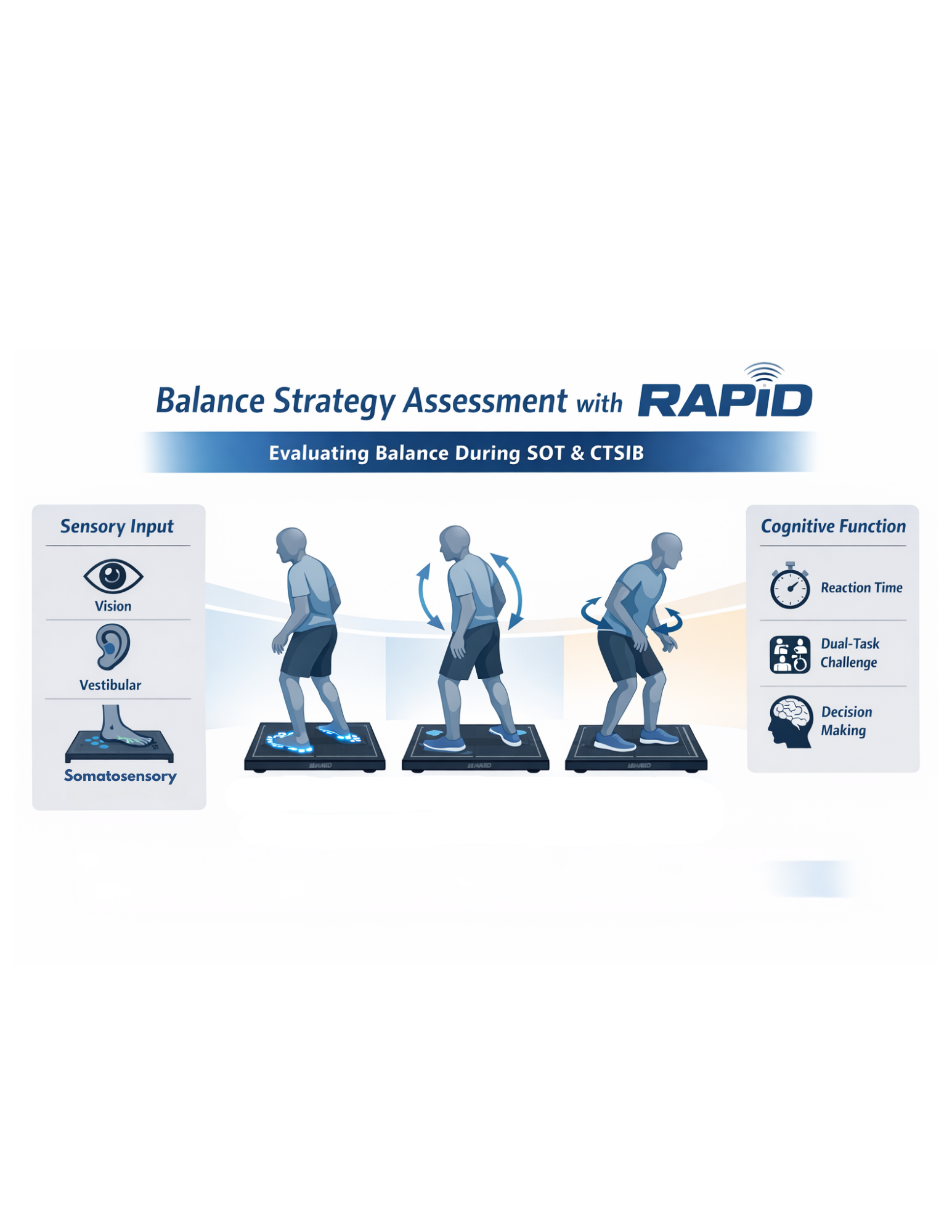
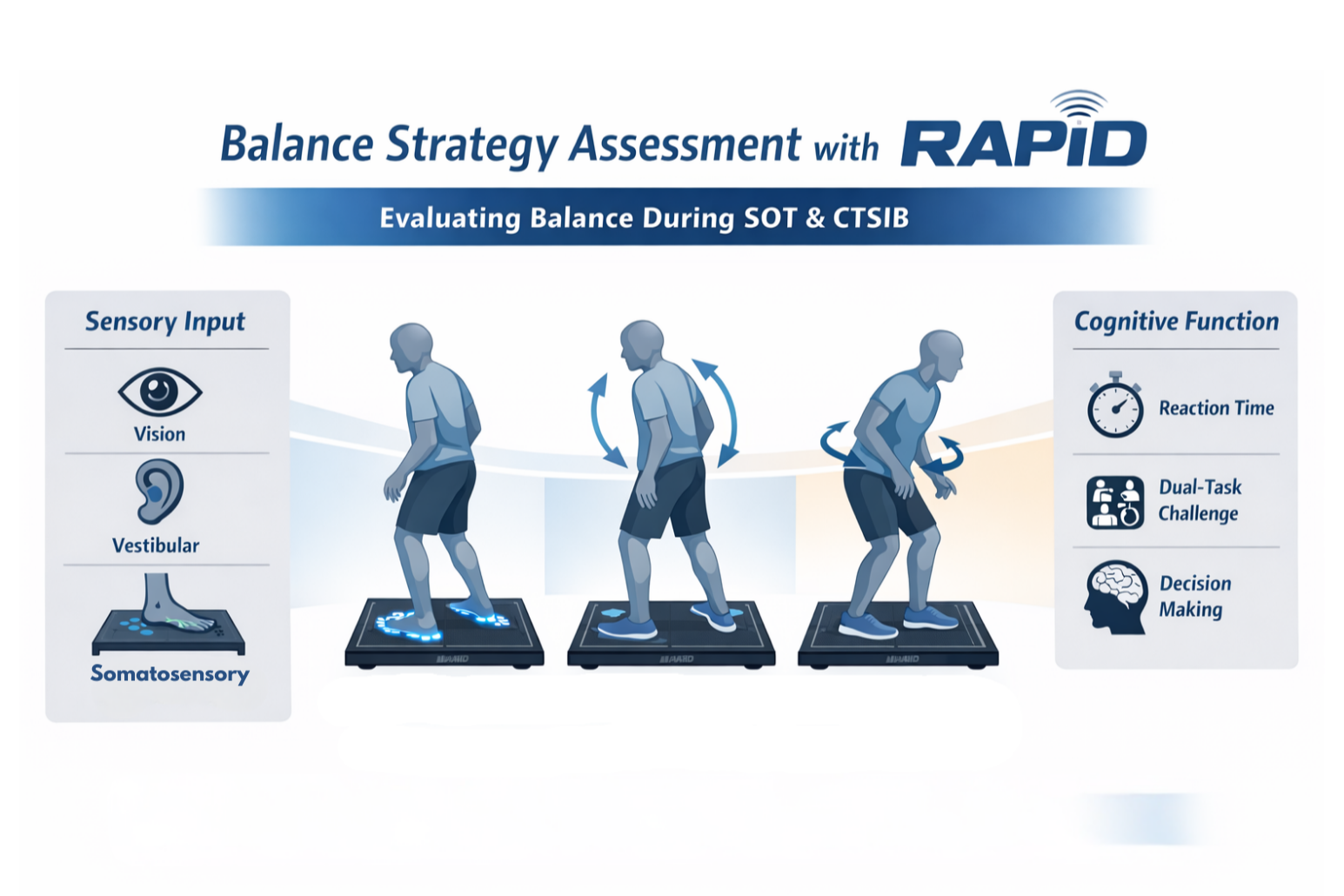
RAPID also captures ankle and hip strategies, identifying how a person maintains balance—whether relying on ankle movements (“ankle strategy”) or larger hip movements (“hip strategy”). Understanding these strategies is critical for:
· Interpreting balance performance
· Identifying deficits
· Guiding targeted interventions
This assessment is particularly helpful in tests such as the Sensory Organization Test (SOT) and the Clinical Test of Sensory Interaction on Balance (CTSIB), both fully integrated in RAPID. By measuring how individuals adjust at the ankle and hip, RAPID decodes each person’s unique balance strategy and provides actionable data for prevention planning.
3. Sensory Testing
RAPID evaluates how effectively the body uses sensory information:
· Balance under different visual conditions
· Stability on varying surfaces
Research demonstrates that declines in plantar sensation and proprioception significantly impair postural control in older adults (Menz et al., 2021).
4. Cognitive Evaluation
RAPID measures real-life functional performance:
· Reaction time
· Dual-task performance
· Decision-making under movement
Dual-task studies confirm that gait stability decreases and fall risk increases when cognitive demand is added to movement (Howcroft et al., 2018).
Objective Testing That Meets Industry Standards
RAPID combines innovation with proven, standardized assessment methods to ensure both accuracy and clinical relevance.
RAPID incorporates widely accepted protocols such as Centers for Disease Control and Prevention’s STEADI (Stopping Elderly Accidents, Deaths & Injuries) initiative, along with other functional balance tests.
These tools provide:
· Validated benchmarks for fall risk
· Consistency across providers and settings
· Alignment with clinical best practices
RAPID also utilizes the gold standard of balance assessment—force and pressure sensing technology(the RAPID Gravity Mat) to objectively measure:
· Center of pressure movement
· Sway velocity and stability
· Load distribution and asymmetry
This high-resolution data enables professionals to make precise evaluations and prescribe targeted interventions (Journal of Foot and Ankle Research, 2023; Springer, 2026).
Evidence in Action: What the Research Shows
A growing body of peer-reviewed research supports a systems-based approach to fall prevention:
· Foot strength and structure: Reduced toe strength and foot dysfunction increase fall risk (Menz et al., 2021; Mickle et al., 2022)
· Plantar pressure: Abnormal pressure patterns correlate with instability and fall risk (Journal of Foot and Ankle Research, 2023)
· Sensory decline: Impaired proprioception and plantar sensation reduce balance control (Menz et al., 2021)
· Cognitive load: Dual-task conditions expose deficits and increase fall likelihood (Howcroft et al., 2018)
· Targeted interventions: Programs combining strength, balance, and sensory training significantly improve outcomes (Trials Journal, 2021)
Together, this evidence confirms that falls are best predicted and prevented when mechanical, sensory, and cognitive systems are evaluated together, not in isolation.
Turning Insight Into Action
Assessment alone isn’t enough.
RAPID translates findings into targeted, personalized interventions, including:
· Foot strengthening to improve stability
· Mobility work to restore proper mechanics
· Sensory-based balance training
· Cognitive-motor exercises to improve reaction and coordination
The Role of Footwear: An Overlooked Factor
Footwear plays a critical role in stability, especially for older adults.
The wrong shoe can:
· Restrict toe splay
· Reduce ground feedback
· Increase instability
· Alter walking mechanics
The right shoe can:
· Allow natural forefoot expansion
· Improve balance and pressure distribution
· Enhance confidence and movement efficiency
· Reduce fall risk
RAPID helps professionals identify the most appropriate footwear based on:
· Foot structure
· Pressure patterns
· Stability needs
Foot Splay: The Missing Link in Stability
Foot splay—the natural spreading of the toes—is essential for balance. A wider forefoot:
· Increases the base of support
· Enhances ground contact and sensory input
· Improves force distribution across the forefoot
· Allows rapid, subtle balance corrections
When footwear allows proper toe splay, older adults maintain a more adaptable and stable platform, reducing fall risk. Narrow or restrictive toe boxes can impair stability and worsen balance deficits over time.
Maintaining Independence Through Better Movement
Falls are not just injuries, they are often the beginning of a decline in independence.
The good news is that fall risk is modifiable.
With the right data and targeted interventions, older adults can:
· Improve balance
· Move with greater confidence
· Stay active and independent longer
The Bottom Line
Falling is not an inevitable part of aging.
It is a signal that one or more systems in the body are no longer working together effectively.
By starting at the ground level, including the often-overlooked role of footwear, and evaluating the full system, RAPID provides professionals with precise data to decode risk and implement effective interventions.
RAPID doesn’t just measure balance. It empowers older adults to move safely, confidently, and independently.